
Eames Lounge Chair & Ottoman

Reupholstering the Eames Lounge Chair & Ottoman with Mod Restoration
The Eames Lounge Chair and Ottoman is one of the most iconic pieces of modern furniture ever created and is one of the most widely purchased chairs. Business Insider recently called it a “status symbol” for the corporate climbers.
Mod expertly reupholsters and refinishes the Eames Lounge Chair & Ottoman, keeping the integrity of the original Eames Lounge Chairs. We only use Herman Miller OEM shock mounts, and for those wanting to keep the 1950's look, we offer a custom black leather to match the original black leather used by Charles & Ray Eames. Click below to get your reupholstery project started.
Vintage vs. Modern Construction
The Eames Lounge Chair, by era
Herman Miller's Label
The Eames Lounge Chair has featured a range of labels and medallions since its introduction in 1956, reflecting changes in production, branding, and manufacturing over time. Early examples typically include round medallions from Herman Miller, while later versions display horizontal labels. These markings, located on the underside of the chair or ottoman, are one of the most reliable ways to identify the era of a piece.
At Mod Restoration, we have reupholstered and restored Eames Lounge Chairs from all production periods, with each piece requiring an understanding of its specific construction details based on its era. Below are representative labels from our workshop, in roughly chronological order. Use them alongside clips, cushion construction, and shock mounts when dating a chair.

1956–1964
Silver/white round metal medallion (“Designed by Charles Eames - Herman Miller”).

1964–1970
Black circular medallion.

1970–1990
Black rectangular label (lowercase “herman miller”).
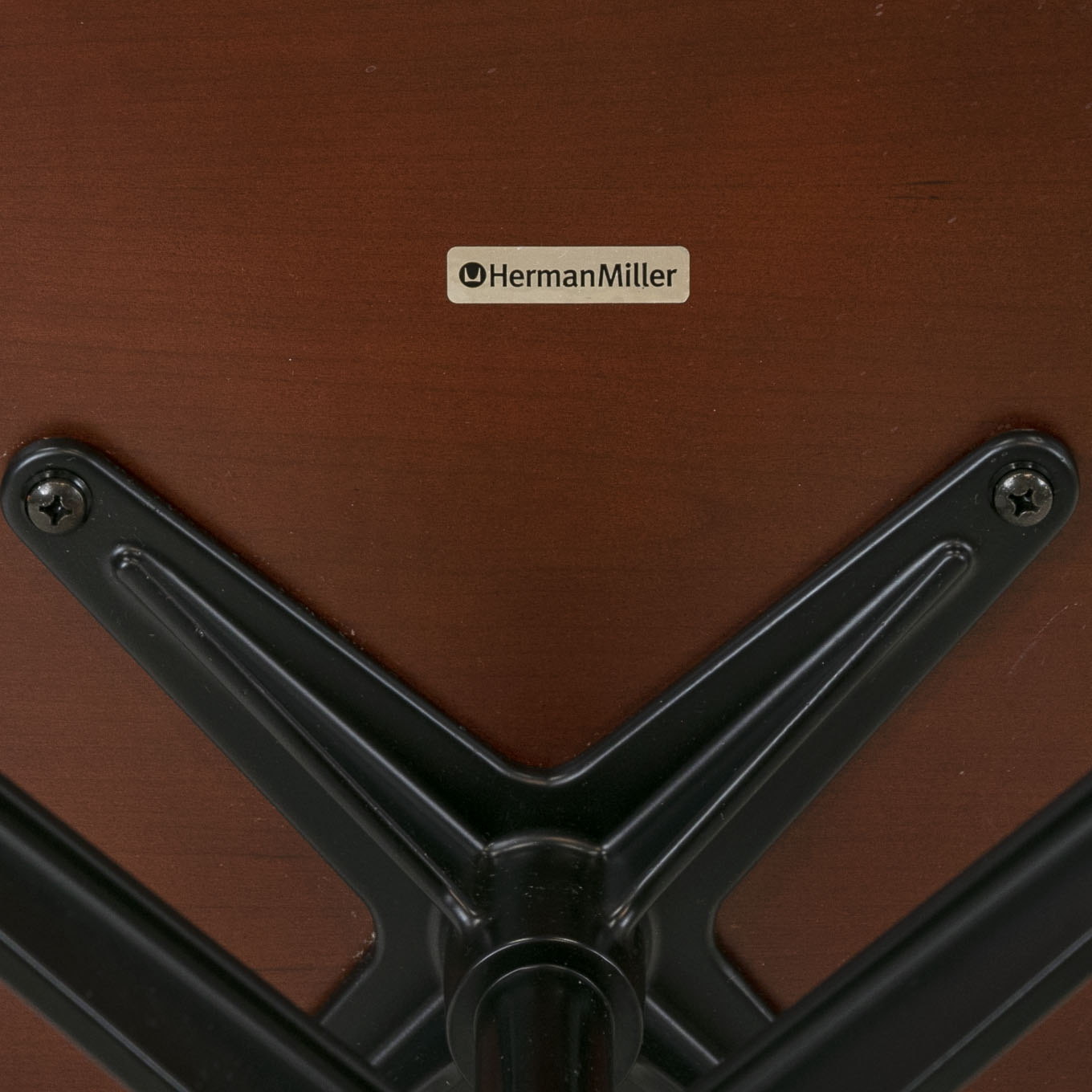
1990s–2000s
Silver rectangular label (capitalized “Herman Miller”).
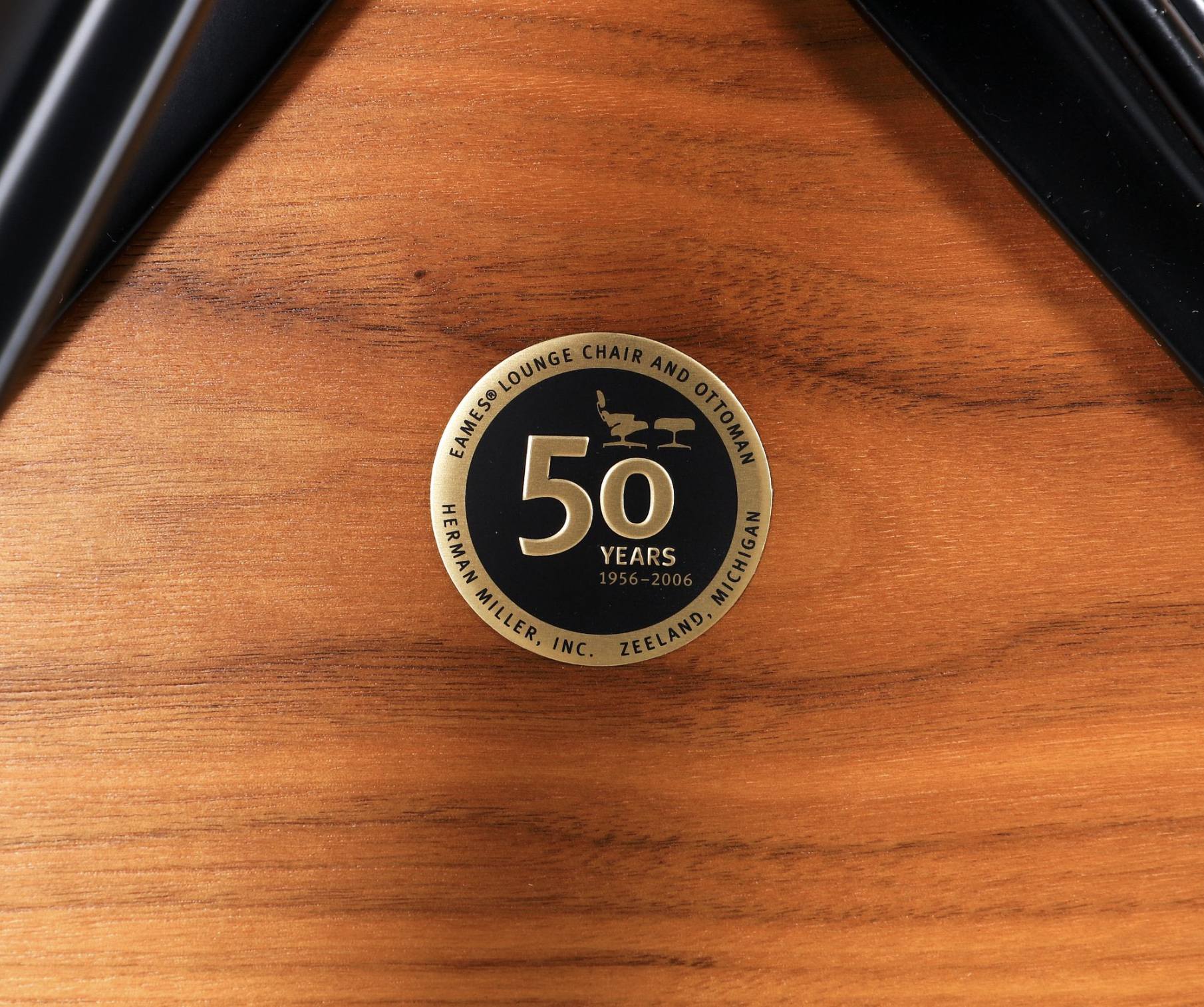
2006 (Anniversary)
50 Year Anniversary medallion.
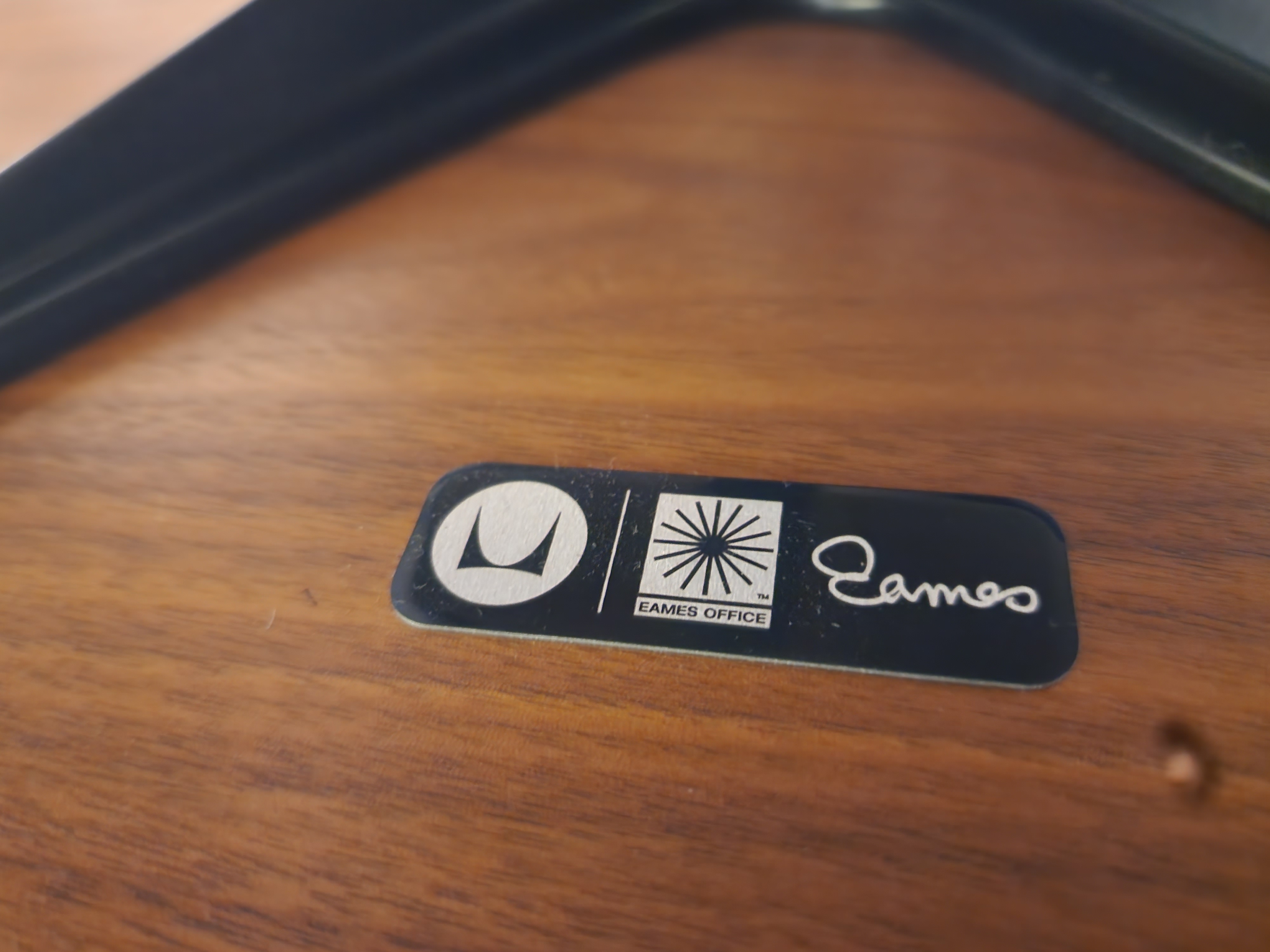
2010–current
Black round-cornered label featuring the Eames signature alongside Herman Miller's logo.

1960s–1980s — Continued Rosewood, Refinement in Production
Production continued primarily in Brazilian rosewood, while walnut was introduced as an alternative veneer option.
- Improved consistency in plywood molding and pressing techniques
- More controlled and uniform finishing processes
- Subtle shift toward consistent sheen and coloration across production
- Shells began as five-ply plywood; ca. 1974 Herman Miller adopted seven-ply construction for additional shell strength.
- That upgrade coincided with continued Brazilian rosewood, so vintage examples from the mid-1970s into the early 1990s may pair seven-ply shells with rosewood veneer.
1990s–Present — Santos Palisander (Rosewood alternative)
Following international restrictions on Brazilian rosewood under CITES, Herman Miller transitioned to Santos Palisander (Machaerium spp.) as a replacement veneer.
- Veneer: Santos Palisander
- Purpose: selected as a visual substitute for rosewood
Key differences from Brazilian Rosewood
- More linear and uniform grain pattern
- Less pronounced, dramatic figuring
- Slight variation in tone, often reading more reddish or purple compared to the deeper brown/black hues of rosewood
This transition marked a significant material shift while maintaining the chair's overall aesthetic intent.

Eames Lounge Chair in Santos Palisander


Current Production — Expanded Wood Options
Today, the Eames Lounge Chair is produced in a range of veneers to suit both traditional and contemporary interiors:
- Santos Palisander
- Walnut
- Ash (typically black-stained)
- White Oak
While the construction and form remain true to the original 1956 design, the expanded material palette reflects evolving design preferences and modern production standards.
Did you know
The first Eames Lounge Chair was made by Charles & Ray Eames in 1956 as a gift for Billy Wilder, the Hollywood director of “Some Like It Hot” and “Irma la Douce”.
Cushion clips, backing, and attachment
The attachment system used on the Eames Lounge Chair has evolved over time, particularly in how the upholstery is secured to the shells. Early production examples from roughly 1956 through the early–mid 1960s used a system of snap fasteners and round metal clips. The upholstery backing was typically made from a compressed fiberboard (hardboard), which allowed snaps to be installed directly into the panel. This system gave the chair a clean appearance, but over time, the hardboard could fatigue, and the snap connections were prone to loosening with repeated use and age.
By the late 1960s into the 1970s and onward, the construction was updated to a more durable system using longer spring steel clips paired with routed cut-outs in the shell backing. This allowed the upholstery to be tensioned more evenly across the shell and improved long-term serviceability. At the same time, the backing material transitioned away from traditional hardboard to more stable injection-molded or formed plastic backings, which are less susceptible to moisture, warping, and failure over time. This later system remains the standard in modern production, offering improved durability while maintaining the original design intent and appearance of the chair.
In the workshop we match clip style and backing type to label era and cushion build. If hardware was substituted in a past repair, we note it and correct the assembly so cushions seat evenly, shells carry load predictably, and upholstery edges track the original seam lines.


Later backing: formed plastic, less prone to moisture and warping than hardboard
The quality of the connections is the key to quality.
— Charles Eames
Shock mount failures we see
Shock mounts are critical to the structure and function of the Eames Lounge Chair. They connect the molded plywood shells to the base, allowing flexibility while maintaining the chair's signature "floating" appearance. Over time, these mounts can fail—leading to movement, creaking, or misalignment between the seat and back. What may seem minor is often structural, not cosmetic.
During restoration, we remove the original mounts and sand and prepare the veneer at the bond area to ensure proper adhesion. If the surface is intact, we install new mounts in the exact factory position. If the failure has damaged the veneer or exposed underlying plies, we replace the affected panel rather than compromising the integrity of the shell. New shock mounts are installed using the correct adhesives and precise alignment for long-term durability and performance.
Six different chairs or details - each image is unique. They illustrate missing mounts, failed rubber, seat and arm contexts, severe shell damage, a modified older mount, and the OEM replacement we install after the landing zone is properly prepared.


OEM replacement mount after shell prep
The mount system evolved from early rubber-on-plate bonds through bracketed eras to today's encapsulated elastomer parts. Across those changes the goal is the same: correct pitch between seat and back, even load into the shells, and a bond line that can be serviced again without guessing.
At Mod Restoration we use genuine Herman Miller shock mounts and manufacturer-approved adhesives. We do not use aftermarket mounts; they often fail early and compromise both safety and authenticity.
Before and After Reupholstery


Eames Lounge Chair FAQs
Ready to restore this piece?
Get a free estimate for restoring your Eames Lounge Chair & Ottoman. Upload photos and receive an estimate range.